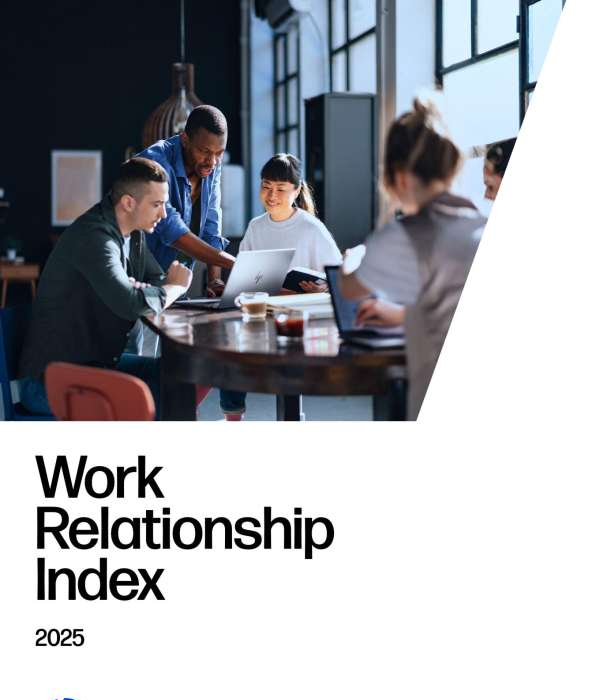
What’s driving the disconnect between employees and work today?
Many knowledge workers feel that work simply isn’t working for them anymore. According to the HP Work Relationship Index 2025, only 20% of knowledge workers say they have a healthy relationship with work, down 8 points from 2024. At the same time, 62% report that their companies’ expectations have increased over the past year.
This creates a workplace that feels more demanding but less rewarding. Several factors are contributing to this disconnect:
- **Rising expectations without support:** Employees are being asked to do more, often without the tools, time, or recognition they need.
- **Perception that profit comes first:** 45% of desk-based workers feel their company is prioritizing profit over people, which erodes trust and engagement.
- **Leadership behavior not matching the message:** Only 15% of knowledge workers say senior leadership demonstrates the behaviors they expect from employees.
- **Limited emotional openness at work:** Just 12% agree that people are encouraged to communicate their emotions at work.
Together, these trends point to a growing gap between organizational strategy and human experience. Employees are reassessing what they want from work and whether their current employer can realistically provide it.
How are younger workers changing expectations of work?
Gen Z and Millennials now make up the majority of the workforce, and they are quietly but clearly reshaping expectations of work.
Younger employees are:
- **Pursuing side hustles:** They are less likely to rely on a single employer for all of their financial and professional needs.
- **Demanding flexibility:** They expect more control over when and where they work, not just occasional flexibility.
- **Looking for purpose-driven leadership:** They want leaders whose actions reflect clear values and a people-first mindset.
When these expectations aren’t met, younger workers are more willing to disengage or move on. They actively seek organizations that align with their values and are quick to question environments that feel transactional or purely profit-focused.
For employers, this means the social contract of work is being reimagined. It’s no longer enough to offer basic benefits and a paycheck. Younger workers are looking for fulfillment, recognition, and leadership that understands the human side of work and is prepared to act on it.
What can companies do to improve employee fulfillment?
To improve fulfillment, organizations need to rethink how technology, leadership, and culture come together in the day-to-day experience of work.
Based on the HP Work Relationship Index 2025 insights, some practical steps include:
1. **Equip people with the right tools and technology**
Make sure knowledge workers have modern, reliable tools that actually make their work easier. This helps reduce friction and shows that the company values their time and effort.
2. **Align leadership behavior with expectations**
With only 15% of knowledge workers saying leaders model the behaviors they ask of employees, there is clear room to improve. Leaders can:
- Demonstrate the same standards they set for others
- Communicate transparently about decisions and trade-offs
- Show consistency between stated values and daily actions
3. **Create a people-centric culture, not just policies**
Policies alone aren’t enough if the culture doesn’t support them. Companies can:
- Encourage open, respectful conversations about workload, wellbeing, and emotions (addressing the current gap where only 12% feel emotions are welcome at work)
- Recognize contributions regularly, not just at review time
- Involve employees in shaping how work gets done
4. **Balance performance and wellbeing**
With 45% of desk-based workers feeling profit is prioritized over people, organizations can:
- Be explicit about how business goals and employee wellbeing are both measured and managed
- Set realistic expectations and adjust them when conditions change
5. **Reimagine the work experience for the modern workforce**
The path forward is less about small, incremental fixes and more about reshaping how work feels and functions. This means designing work environments—physical, digital, and cultural—where people feel seen, supported, and empowered to grow.
When companies align technology, leadership, and culture around people, they create conditions where fulfilled employees can drive better business outcomes in a sustainable way.
.png "Fuselogix L.L.C.")



 Sign in with LinkedIn